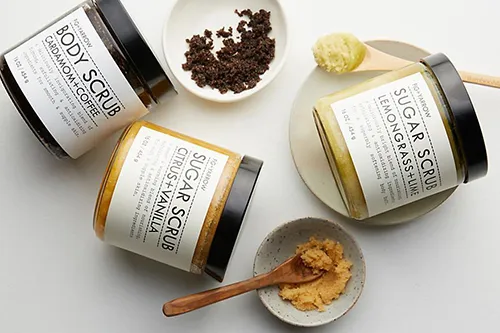
Common body scrubs use sugar, salt, or other scrub particles. They are mixed with oils, butters, or a cream or cleansing base. Some formulas also contain glycerin, emulsifiers, preservatives, fragrance, and plant extracts.
Each ingredient has a different role. Some exfoliate the skin. Others affect softness, rinsing, texture, or product protection.
The best formula does not always have the most ingredients or the strongest scrubbing feel. The particles, base, and way you use the product all matter. This guide explains common ingredients, compares scrub types, and covers what to consider when choosing or developing a product.
Common Body Scrub Ingredients and Their Functions
First, separate the exfoliating ingredients from those that form and protect the base. A plant extract or fragrance may stand out on the label without doing the exfoliating.
| Ingredient or group | Examples | Main role in a body scrub | What to check |
|---|---|---|---|
| Soluble exfoliating particles | Sugar and salt | Physically exfoliate the skin and dissolve in contact with water | Particle size, shape, amount, and feel during use |
| Other exfoliating particles | Coffee particles, jojoba esters, and selected plant-derived powders | Create a different texture and scrubbing feel | Consistent particles, abrasiveness, rinsing, and residue |
| Emollient oils | Sunflower oil, jojoba oil, coconut oil, and sweet almond oil | Add slip and affect softness and oily feel after rinsing | After-feel, ingredient sensitivities, and formula stability |
| Butters and structuring ingredients | Shea butter, cocoa butter, and fatty alcohols | Create a richer or firmer base | Ease of scooping and spreading, and texture changes during storage |
| Humectants | Glycerin and suitable glycols | Attract water and contribute to the formula’s moisture-related properties | How they work with the base and affect the finished product’s feel |
| Emulsifiers | Suitable emulsifying waxes and glyceryl stearate-based systems | Help oil and water interact in cream or rinse-off formulas | Formula type and how the product rinses |
| Cleansing ingredients | Suitable surfactant blends | Add cleansing or foam to a wash-style scrub | Cleansing strength and skin feel after rinsing |
| Preservation system | A formula-compatible antimicrobial system | Help control microbial growth where needed | Fit with the formula, use conditions, and supporting tests |
| Antioxidants | Tocopherol and suitable antioxidant blends | Help protect oils that are prone to oxidation | They do not replace an antimicrobial preservation system |
| Optional sensory ingredients | Fragrance, color, and plant extracts | Affect scent, appearance, and how the product is positioned | Suitability, compatibility, and evidence for advertised benefits |
Not every scrub needs every ingredient group. An oil-based sugar scrub and a creamy exfoliating wash have different needs.
Ingredient suppliers such as MakingCosmetics publish examples of salt scrubs, exfoliating creams, and cleansing scrubs. These show how much formulas can vary.
Choosing Between Sugar Salt and Other Exfoliants
Sugar
Sugar is common in body scrubs. It may appear on the ingredient list as sucrose. It gives the product a grainy texture and dissolves in water.
Fine sugar can feel different from larger crystals, especially in a base that provides plenty of slip.
However, “sugar scrub” does not always mean gentle. The amount of sugar, crystal shape and size, base, rubbing pressure, and skin condition all affect the experience.
Salt
Salt scrubs often use sodium chloride or sea salt. As with sugar, the grade and particle features matter. Fine salt can feel very different from a coarse salt-and-oil blend.
Judge the finished product rather than assuming all salt scrubs exfoliate in the same way. Mineral content or the salt’s place of origin does not, by itself, prove a therapeutic benefit.
Coffee and Plant-Derived Particles
Coffee particles give scrubs a familiar look and texture. Unlike sugar and salt, they do not simply dissolve during rinsing. Residue and cleanup are therefore worth considering.
Ground shells, seeds, and other plant particles also vary in shape and texture. “Natural” does not tell you how abrasive a particle is.
For commercial development, ask for clear raw-material specifications. Do not assume that different powders can replace one another.
Jojoba Esters and Other Manufactured Particles
Manufactured scrub particles can offer more controlled size and shape. Their performance still depends on the amount used, the base, and how the product is applied.
An ingredient name alone does not prove that a finished scrub suits sensitive skin.
For any exfoliant, check how the product spreads and rinses when used as directed. A stronger scratching feel does not mean better skincare.
How Oils Butters and the Base Change a Scrub
Two scrubs can use the same exfoliant and feel very different. The base affects much of the slip, thickness, rinsing, and feel left on the skin.
| Scrub format | Typical structure | What to evaluate |
|---|---|---|
| Oil-based scrub | Scrub particles mixed into oils, sometimes with butters or ingredients that add structure | Oil separation, ease of scooping and spreading, and residue after rinsing |
| Self-emulsifying scrub | An oil-rich base with an emulsifier that interacts with water during use | How evenly it disperses and whether the rinse feel matches the brief |
| Cream scrub | An emulsion of water and oil phases containing scrub particles | Particle stability, even texture, preservation, and skin feel |
| Foaming scrub | A cleansing base containing suspended scrub particles | Foam, cleansing feel, even particle distribution, and ease of rinsing |
The Handcrafted Soap and Cosmetic Guild explains emulsified scrubs as a way to change how an oil-rich product interacts with water.
Some products called emulsified scrubs contain no water in the jar. They emulsify during use. Others already contain a water phase. The name alone does not tell you the composition.
Oils and butters mainly add softness and texture. Glycerin has a different role: it attracts water as a humectant.
Adding more of these ingredients does not always improve a scrub. Aim for a balanced formula that rinses and feels as intended.
For shoppers, decide whether you want a richer finish, a creamier rinse, or a cleansing wash. For brands, put that preference into the brief before choosing a long list of featured ingredients.
DIY Ingredients Preservation and Safe Use
A Simple Ingredient List Is Not a Complete Safety Assessment
Many homemade recipes start with sugar or salt and an oil. This shows the basic structure of an oil-based scrub. It does not establish a shelf life or make the mix ready to sell.
Adding water, fresh ingredients, or a water-containing extract changes the formula. Mixing finished products together also changes a formula that was developed and tested in another form.
Do not assume a kitchen recipe can become a commercial product without further development.
Vitamin E Is Not a Substitute for Preservation
Antioxidants and antimicrobial preservatives address different problems. Vitamin E can help protect oils from oxidation. It does not replace protection against bacteria, yeast, and mold.
Bramble Berry’s preservation guidance makes this distinction clear.
A scrub made without added water still needs a review of how it will be used. A jar opened often in the shower may be exposed to water and handling.
Preservation choices should account for the full formula, packaging, and likely use. The phrase “water-free” is not enough on its own.
The FDA identifies raw materials, inadequate preservation, packaging, storage, and consumer handling as possible sources of cosmetic contamination.
Keep containers clean, follow storage directions, and avoid adding water to finished products. Smell and appearance alone cannot show whether a product is free from harmful microbes.
Choose Exfoliation That Your Skin Tolerates
The American Academy of Dermatology recommends gentle exfoliation. It advises against exfoliating sunburned skin or areas with open cuts or wounds.
Moisturize afterward. Adjust how often you exfoliate based on the product and your skin’s response.
Sensitive skin may not tolerate physical scrubbing well. Stop using a scrub if it causes burning or persistent irritation.
Take extra care if you already use retinoids or other exfoliating products. No single schedule suits everyone.
Fragrance and essential oils are optional. They are not needed for exfoliation, and natural origin does not guarantee that they suit everyone.
If fragrance is a known concern, choose a fragrance-free option and review the full ingredient list.
Developing a Body Scrub Formula for Your Brand
A useful brief connects ingredients to the experience you want. Instead of asking for “a natural scrub for all skin types,” describe the customer, body area, scrub feel, rinsing, and packaging.
Xiangxiang Daily offers private label body scrub development. Buyers can discuss the exfoliant, base, fragrance, and packaging together. These choices should work as parts of one product.
| Decision | What to include in the brief |
|---|---|
| Customer and use | Retail or professional use, intended body area, and desired experience |
| Exfoliating system | Preferred particle type and the texture to compare in samples |
| Base format | Oil-based, self-emulsifying, creamy, or foaming |
| Sensory requirements | Spreading, rinse feel, fragrance, color, and acceptable residue |
| Packaging | Jar or another suitable format, fill size, closure, and where it will be used |
| Commercial scope | Sales country, quantity per SKU, target cost, and required documents |
Review Samples Against the Same Criteria
Use the same amount and application method when comparing samples. Record the particle feel, spreading, rinsing, residue, and ease of using the package.
A thick scrub may look appealing in a sample jar. It may still need changes for dispensing or production.
For transport and storage, ask how the test plan covers separation, texture changes, leaks, and relevant temperatures.
Climate should help guide testing. It should not be used to assume that everyone in a country wants the same scent or formula.
To begin, send Xiangxiang Daily your body scrub brief. Include the target market, preferred texture, pack size, and planned quantity. Add a reference product if it helps explain the experience you want.
FAQs About Body Scrub Ingredients
What Are the Main Ingredients in a Body Scrub
A body scrub contains an exfoliating material, such as sugar or salt, and a base that carries it. The base may include oils, butters, water, emulsifiers, or cleansing ingredients. Preservation and other supporting ingredients must suit the full formula.
Is Sugar or Salt Better for a Body Scrub
Neither is always better. Compare the particles, base, and intended use. Fine particles may feel less abrasive than coarse ones. But “sugar” or “salt” alone does not tell you how gentle a scrub is.
What Are the Best Body Scrub Ingredients for Dry Skin
If your skin tolerates exfoliation, a less abrasive scrub with a softening base may feel more comfortable than a strongly cleansing one. Oils and butters can affect softness and after-feel.
For very dry or irritated skin, it may be better to skip scrubbing and focus on moisturizing.
Do Body Scrubs Need Preservatives
Body scrubs need a suitable plan to control microbial risks. Water-containing formulas generally need suitable preservation. Water-free products still need a review of their ingredients, packaging, and possible water exposure.
Do not assume salt, sugar, essential oils, or vitamin E provide enough protection on their own.
Can I Add Essential Oils or Extracts to a Finished Scrub
Adding ingredients changes the formula. It may affect fragrance exposure, texture, stability, and preservation. Use finished products as directed.
For commercial changes, have the additions assessed as part of a new formula. Do not simply mix them into an approved product.
How Long Does a Homemade Body Scrub Last
There is no reliable shelf life that applies to every homemade scrub. Ingredients, cleanliness, water exposure, packaging, and storage all matter.
An online recipe or the absence of visible mold does not prove months of safe storage. Products made for sale need suitable development and testing.