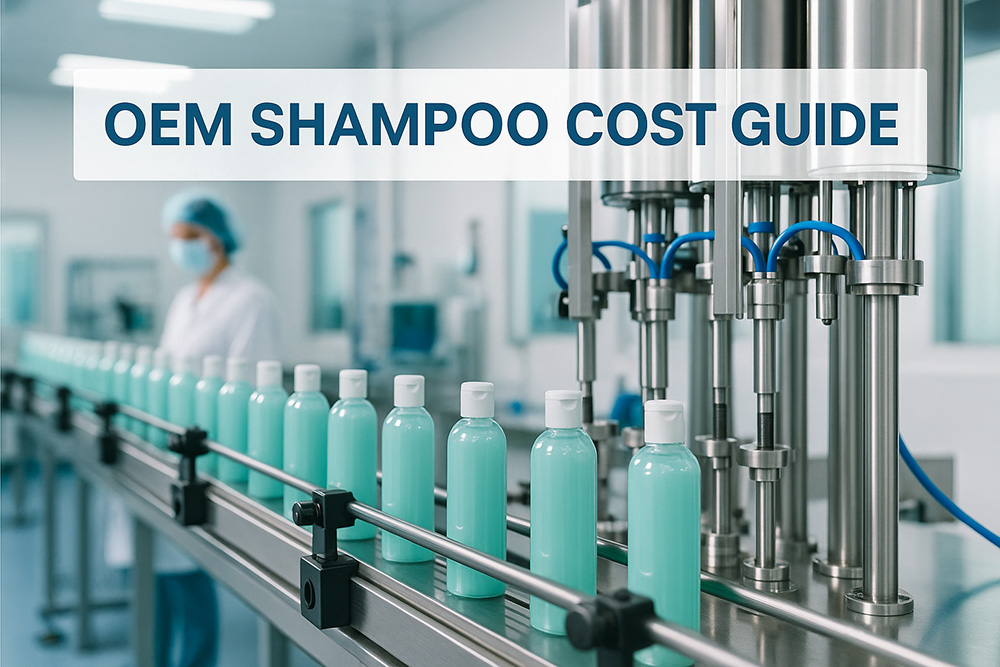
OEM shampoo cost depends on formula, packaging, order volume, testing, compliance, and shipping terms.
For B2B buyers, the cheapest quote is not always the best option.
A good quote should show what is included, what is excluded, and what may change after sampling or packaging confirmation.
This guide explains how OEM shampoo pricing works from raw materials to finished products.
It is written for brands, distributors, retailers, salons, and e-commerce sellers comparing custom shampoo suppliers.
As a personal care manufacturer, Xiangxiang Daily supports shampoo, conditioner, hair care, body care, and skin care products for private label and OEM/ODM buyers.
What Drives OEM Shampoo Cost?
OEM shampoo cost is shaped by several cost layers.
The main drivers are:
- Formula: surfactants, conditioners, actives, fragrance, preservatives, and “free-from” claims.
- Packaging: bottle material, closure, decoration, molds, and packaging MOQ.
- Manufacturing: batch size, filling speed, labeling, cleaning, and quality checks.
- Compliance: testing, safety documents, claim review, and market requirements.
- Logistics and Incoterms: EXW, FOB, DDP, freight, duties, and local delivery.
A simple pricing equation can help buyers compare quotes.
EXW Unit Price ≈ (Formula $/kg × Fill Weight kg) + Primary Packaging + Filling/Labeling + QC Allocation + Setup Amortization + Factory Margin
This formula is only a guide.
The final price may change after formula testing, packaging confirmation, artwork.
The final price may change after formula review, and order volume confirmation.
OEM vs ODM vs White Label
OEM, ODM, and white label projects have different cost structures.
- OEM: You bring the concept and brand. The manufacturer produces to your specifications. Formula and packaging can be customized.
- ODM: The manufacturer provides ready-to-customize base formulas and packaging options. You adjust scent, color, actives, label, or packaging details.
- White Label: The product is already developed. You mainly change the logo or label. This is usually the fastest option, but it offers the least uniqueness.
OEM gives the most control.
ODM is usually faster and more cost-predictable.
White label is useful for fast testing, but the product may be less differentiated.
For buyers comparing project types, our custom shampoo manufacturer page can help you understand how custom shampoo development works.
Cost Stack Overview
OEM shampoo cost is not only about the liquid formula.
The finished unit price includes several cost layers.
- Formula BOM: surfactant system, conditioners, silicones or silicone-free alternatives, actives, fragrance, color, preservatives, chelators, thickeners, pearlizing agents, and water.
- Primary packaging: bottle, tube, pouch, closure, pump, label, printing, insert, or sealing component.
- Secondary packaging: cartons, dividers, shrink-wrap, master cases, and export cartons.
- Manufacturing: batching, filling, capping, labeling, cleaning, line changeovers, and normal production waste.
- Quality and compliance: stability tests, microbiology checks, compatibility tests, claim support, and safety documents.
- One-time or amortized costs: mold, tooling, artwork pre-press, pilot batch, and setup fees.
- Logistics: inland freight, export documents, ocean or air freight, insurance, duties, and local delivery.
When comparing suppliers, ask for the cost scope clearly.
A lower unit price may exclude testing, documents, packaging upgrades, or freight.
Formula Cost Explained
Formula cost is often called BOM cost.
BOM means Bill of Materials.
For shampoo, the biggest formula cost drivers include surfactants, conditioners, actives, fragrance, preservatives, and claim requirements.
- Surfactant choice: sulfate systems are usually more cost-efficient. Sulfate-free systems often cost more.
- Conditioning approach: silicones can be economical. Silicone-free or natural-origin conditioning systems may increase cost.
- Actives and claims: anti-dandruff actives, caffeine, biotin, peptides, botanical complexes, and special claim ingredients can raise cost.
- Fragrance: custom fragrance, allergen limits, high oil load, or premium scent direction can raise cost.
- Clean or green standards: vegan, natural-origin, COSMOS-ready, or EWG-friendly ingredient direction can increase BOM.
Illustrative formula cost ranges, ex-works:
- Basic daily-use OEM shampoo: $1.2–$3.5/kg.
- Performance or sulfate-free shampoo: $3.5–$8/kg.
- Premium, active-rich, or natural-cert-ready shampoo: $8–$15+/kg.
Quick math: A 300 mL fill is about 0.30 kg. Formula cost per unit = formula $/kg × 0.30.
Formula cost should not be judged alone.
A low-cost formula may still fail if it has weak foam, poor rinse feel, unstable viscosity, or a poor after-feel.
Ingredient Families That Move the Cost Needle
When planning OEM shampoo, some ingredient groups affect cost more than others.
They also affect foam, texture, rinse feel, claims, and user experience.
- Primary surfactants
- Cost-efficient systems may use SLES/ALES with CAPB for good foam and clarity.
- Premium or sulfate-free systems may use APG, glucosides, isethionates, or sarcosinates.
- Conditioners and anti-frizz agents
- Economical options may include silicones such as dimethicone or amodimethicone, plus polyquats.
- Silicone-free systems may use cationic biopolymers or esters. These can cost more but support a cleaner label story.
- Scalp and performance actives
- Oil-control and soothing directions may use niacinamide, zinc PCA, panthenol, or botanical complexes.
- Anti-dandruff actives vary by market, so regulatory status should be checked before confirming claims.
- Rheology and appearance
- Thickeners, pearlizing agents, and clarity modifiers affect appearance, viscosity, and filling behavior.
- Preservation and compliance
- Preservative systems, allergen labeling, IFRA alignment, and local rules can affect both formula choice and cost.
Tip: Choose one hero benefit first.
Do not stack too many overlapping actives.
This helps control BOM while keeping the product story clear.
Packaging Cost Levers
Packaging can change the unit cost quickly.
This is especially true for small runs, custom molds, pumps, sleeves, or premium materials.
- Material: PET is usually cost-efficient. HDPE, PP, PCR content, glass, and aluminum may cost more.
- Closure: flip-top and disc caps are usually economical. Pumps and lock pumps cost more.
- Decoration: pressure-sensitive labels are usually cheaper than screen printing, hot stamping, metallic effects, or sleeves.
- Coloring: custom masterbatch, opaque finish, soft-touch finish, and heavy tints can add cost.
- Tooling: custom bottle molds add one-time cost. Stock molds avoid tooling cost.
- MOQ: labels may start at lower quantities, while custom bottles often need higher order volumes for better pricing.
Indicative per-unit ranges for 300 mL packaging in larger orders:
- Stock PET bottle with flip cap: $0.12–$0.22.
- Single label: $0.03–$0.08.
- Pump upgrade: +$0.15–$0.35.
Packaging should match the sales channel.
Amazon and e-commerce orders need shipping-safe packaging.
Retail shelves need clear front-label communication.
Salon lines may need a more premium look.
Distributor products often need strong cartons and practical bottle sizes.
Manufacturing and Overheads
Manufacturing cost includes more than filling the bottle.
It also includes labor, cleaning, line setup, quality checks, and production loss.
- Batching: labor, energy, cleaning, and yield losses.
- Filling and labeling: line speed, changeovers, rejects, and label application.
- QA/QC: in-process checks and finished-goods testing.
- Setup allocation: setup fees spread across the production run.
- Small-run impact: low MOQs often carry higher cost per unit because setup cost is divided by fewer units.
Typical illustrative allocations:
- Filling and labeling: $0.07–$0.18 per unit.
- QA allocation: $0.03–$0.06 per unit.
These ranges are only for comparison.
The real cost depends on formula viscosity, packaging type, line speed, inspection needs, and production volume.
Compliance, Testing, and Claims
Compliance cost depends on the target market and claim depth.
A simple daily shampoo usually needs fewer documents than an active-rich or claim-heavy product.
- Stability and compatibility: real-time or accelerated tests, plus packaging interaction checks.
- Microbiology: preservative efficacy, challenge testing, and total plate count checks where needed.
- Safety: safety assessment, SDS, IFRA compliance, and market-specific documents.
- Regulatory support: INCI review, allergen labeling, EU CPNP support, UK SCPN support, and U.S. MoCRA facility registration or product listing support where applicable.
- Budget signals: essential tests and documents may range from $500–$3,000+ per SKU depending on market, product type, and claim depth.
Claims can affect cost.
For example, “sulfate-free,” “anti-dandruff,” “color-safe,” “vegan,” or “natural-origin” may require different formula choices, documents, or claim support.
Buyers should confirm claim wording before printing labels.
For factory-side checks, buyers can review our personal care quality control page.
Volume, MOQ, and Economies of Scale
MOQ has a direct effect on OEM shampoo cost.
Small orders usually have higher unit cost.
Larger orders can reduce formula, packaging, setup, and logistics cost per unit.
- OEM shampoo MOQ commonly ranges from 3,000–10,000+ units depending on formula and packaging.
- Bigger batches may improve raw material pricing and reduce setup cost per unit.
- Higher volumes can unlock better packaging quotes.
- Scaling from low to mid volumes may reduce unit cost by 10–30%, depending on the project.
- At very high volumes, cost reductions may become smaller.
Buyers should compare MOQ with the real sales plan.
A lower MOQ is useful for market testing.
A higher MOQ may be better when the brand already has stable demand.
Worked Examples: Three OEM Shampoo Scenarios
Assumptions: 300 mL fill, about 0.30 kg. EXW pricing. 20% factory margin added to direct costs. Numbers are illustrative for comparison.

What to notice:
- The same bottle can become cheaper at higher volume.
- Formula complexity becomes more important as claims increase.
- Setup amortization can make small runs more expensive per unit.
- ODM base formulas and stock packaging can help first orders stay cost-predictable.
Use these scenarios as a comparison tool.
Your real quote may change based on formula, packaging, testing, order size, and shipping terms.
From EXW to Landed Cost
The factory unit price is not the final landed cost.
Buyers should also consider freight, insurance, duty, tax, and local delivery.
Incoterms cheat sheet:
- EXW: You pick up at the factory and handle export, freight, import, and delivery.
- FOB: The supplier delivers to port and clears export. You handle ocean or air freight and import.
- DDP: The supplier delivers to your door with duties paid. It is usually simpler, but the quote may be higher.
Landed Cost = EXW/FOB Unit Price + Freight Per Unit + Insurance + Duty/Tax + Local Delivery
Shipping by sea can reduce cost if your launch timeline allows it.
Carton design, pack count, and bottle geometry can also affect CBM and freight cost.
Lead Times and Project Plan
OEM shampoo projects usually take several weeks after the brief is confirmed.
Custom packaging or special testing can extend the timeline.
- Brief and RFQ: 2–5 business days.
- Lab samples, version 1: 1–2 weeks.
- Revisions and pre-production sample: 1–2 weeks.
- Packaging procurement: 3–6 weeks for stock packaging, or 6–10+ weeks for custom packaging.
- Manufacturing and QA: 1–3 weeks.
- Total to ship: usually 6–12 weeks after formula, packaging, and artwork approvals.
Packaging is often the biggest timing risk.
Approve artwork early to avoid delays, rush fees, or air-freighting components.
RFQ Template for OEM Shampoo
Use this template to request a clearer quote from a shampoo manufacturer.
Email subject: RFQ – OEM Shampoo, 300 mL, Target EXW/FOB, Region: ___
Product details
- Positioning: daily, anti-dandruff, color-safe, sulfate-free, silicone-free, or natural-leaning.
- Hair type and claims: oily scalp, volumizing, anti-frizz, dry hair, sensitive scalp, or color care.
- Active targets: caffeine, niacinamide, zinc PCA, panthenol, botanical extracts, or other target ingredients.
- Fragrance: scent direction, allergen limits, and IFRA region.
- Color: clear, tinted, pearlized, or opaque.
- Texture: viscosity target, clarity, pearl effect, and preferred after-feel.
- pH window, preservative preferences, and “free-from” list.
Packaging details
- Format: bottle, tube, or pouch.
- Capacity: 300 mL or other target size.
- Closure: flip cap, disc cap, pump, or custom closure.
- Material and color, including PCR content if needed.
- Decoration: label, screen print, sleeve, hot stamp, or other finish.
- Secondary packaging: unit box, shrink-wrap, master case, or gift set.
- Custom mold requirement, drawings, and expected annual volume.
Order and commercial details
- Target MOQ and annual forecast.
- Incoterm: EXW, FOB, or DDP.
- Destination port or delivery country.
- Required certifications, such as GMP, ISO 22716, cruelty-free, vegan, or COSMOS-ready support.
- Testing and documents needed, such as stability, challenge test, CPSR, notification support, SDS, COA, or COC.
- Target unit price range and launch deadline.
- Artwork handoff date, barcode owner, and legal text owner.
Cost Optimization Playbook
Buyers can reduce OEM shampoo cost without damaging quality if the project is planned well.
- Start with an ODM base. Then customize scent, color, actives, or packaging. This keeps cost more predictable.
- Choose one hero claim. Do not stack too many overlapping actives.
- Use stock packaging for first runs. Save custom molds for higher annual volumes.
- Simplify decoration. Start with one label and a clean design before using metallic effects or complex sleeves.
- Bundle SKUs carefully. Shampoo and conditioner sets can help reach better packaging or raw material brackets.
- Approve artwork early. This helps avoid rush fees and component delays.
- Set realistic specs. Practical pH and viscosity windows can reduce rejects and rework.
For Amazon-focused projects, buyers can also review our guide on OEM shampoo cost optimization for Amazon sellers.
Certified OEM/ODM Shampoo Manufacturer
Working with the right manufacturer can make the cost plan easier to control.
A reliable supplier should support formula development, packaging sourcing, sampling, production, quality checks, and export documents.
Xiangxiang Daily is a professional OEM/ODM shampoo manufacturer serving brands, distributors, and retailers worldwide.
Our plants operate under Good Manufacturing Practice and quality systems to support stable, compliant, and scalable shampoo production.
Certification and compliance capabilities may include:
- ISO 22716 Cosmetics GMP, GMPC, ISO 9001 quality system, and optional ISO 14001 environmental management.
- Social compliance audits, such as BSCI or SMETA, upon request.
- Regulatory support, including MoCRA-ready documentation, EU CPNP support, UK SCPN support, CPSR support, IFRA compliance, SDS, COA, and COC issuance.
- Testing support, including microbial testing, preservative efficacy testing, stability checks, compatibility checks, packaging interaction checks, and routine QC checkpoints.
- Sustainable sourcing options, such as naturally derived surfactants, RSPO MB-eligible inputs, and PCR packaging, upon request.
Share your target market and retailer requirements during the RFQ stage. We can help prepare a suitable compliance pack based on your project needs.
Quality-Control and Documentation You Can Expect
Quality control affects both cost and long-term product stability.
Buyers should confirm what checks are included before approving bulk production.
- Batch-level records: raw material traceability, packaging traceability, retained samples, COA, and COC.
- In-process controls: pH checks, viscosity checks, fill-weight checks, torque checks, and seal checks.
- Finished-goods testing: microbiology checks, stability checkpoints, leak tests, and drop tests when required.
- Regulatory file: INCI list, SDS, IFRA statement, allergen disclosure, and label review.
- Change control: formal approval for raw material or packaging substitutions to protect batch consistency.
A low quote without clear quality control may create higher risk later.
Common risks include leakage, viscosity shift, fragrance change, label failure, claim issues, and batch inconsistency.
Work With Us
Need a costed proposal and first lab sample?
Share your OEM shampoo brief with our team.
We can help review formula options, ODM base formulas, packaging routes, MOQ, compliance needs, and target cost.
- What we can include in the quote: formula BOM highlights, claim options, packaging specs, MOQ, EXW/FOB pricing, testing plan, and project timeline.
- How to contact us: Send your OEM shampoo brief through our website inquiry form, and our team will help review formula, packaging, MOQ, and target cost.
- Details to include: target price band, volume forecast, market of sale, launch timeline, packaging idea, and certification expectations.
Many new brands start with an ODM base formula and stock packaging. They can move to a fully custom formula once sales volume becomes more stable.
OEM Shampoo FAQ
What is a typical MOQ for OEM shampoo?
OEM shampoo MOQ commonly ranges from 3,000 to 10,000+ units.
The final MOQ depends on formula, bottle type, pump, label, sleeve, custom mold, and packaging supplier requirements.
How can I lower OEM shampoo cost without losing quality?
Start with an ODM base formula.
Use stock PET packaging with a simple closure.
Keep the label clean and focus on one hero claim.
This can reduce early cost while keeping the product stable and marketable.
How long does an OEM shampoo project take?
Plan for 6–12 weeks after formula and artwork approval.
Custom packaging, special testing, or delayed artwork can extend the timeline.
Do sulfate-free OEM shampoos always cost more?
Usually, yes.
Alternative surfactants often cost more than standard sulfate systems.
They may also need extra conditioning support to improve foam, rinse feel, and after-feel.
What hidden costs should I watch?
Watch for tooling, pre-press, pilot batches, extra microbiology or compatibility tests, rush fees, packaging changes, and logistics beyond EXW or FOB.
Can I order shampoo concentrate and dilute it locally?
Sometimes.
This may reduce freight cost, but it adds local blending, QA, and responsibility questions.
Buyers should agree on specifications, process control, and testing responsibilities before choosing this route.
What is the difference between EXW, FOB, and DDP pricing?
EXW is the factory pickup price.
FOB includes export delivery to port.
DDP includes delivery to your door with duties paid.
The same product can look very different in cost depending on Incoterms.
Can Xiangxiang Daily support OEM shampoo cost planning?
Yes.
Xiangxiang Daily can support formula review, ODM base selection, custom shampoo development, packaging sourcing, MOQ planning, samples, production, quality checks, and export preparation.
Final Take
OEM shampoo cost is shaped by formula, packaging, MOQ, testing, compliance, and shipping terms.
Buyers should not compare quotes by unit price alone.
Compare the full cost scope.
Check what is included in formula, packaging, testing, documents, and Incoterms.
If you are new to OEM shampoo, start with an ODM base formula.
Then choose stock packaging and a volume that reaches key price breaks.
Use the RFQ template above to get quotes you can compare fairly.
Then review formula complexity, packaging choices, testing needs, and Incoerms to understand your true landed cost.