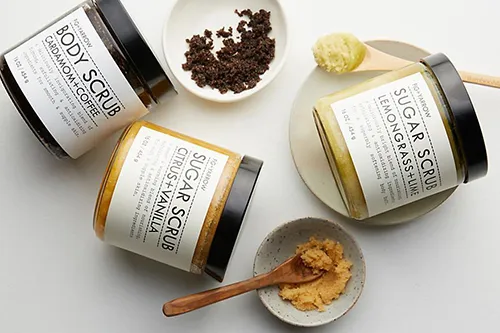
Body scrub ingredients usually include sugar or salt mixed with oils, butters, or a cream base. The grains help remove dead skin cells. The base helps the scrub spread and leaves skin feeling soft.
Some scrubs also contain glycerin, fragrance, and ingredients that help them rinse off or stay fresh. Each has a role. More ingredients or a rougher feel do not always make a scrub better.
Common Body Scrub Ingredients and What They Do
A scrub has two main parts: the grains and the base. The grains loosen dead skin. The base holds them together and affects how the product feels.
| Ingredient | Main role | What to check |
|---|---|---|
| Sugar and brown sugar | Scrub the skin and dissolve in water | Grain size and roughness |
| Sea salt and Epsom salt | Add a grainy scrub texture | Crystal size and skin feel |
| Coffee and plant powders | Add scrub particles | Rough edges and residue |
| Coconut oil and other oils | Help the scrub glide and soften skin | How oily skin feels after rinsing |
| Shea butter and cocoa butter | Make the base thicker and richer | How well it spreads |
| Glycerin | Attracts water | How it works in the full formula |
| Emulsifiers | Help oil mix with water | How easily the scrub rinses off |
| Preservatives | Help control harmful microbes | Whether they suit the formula |
Fragrance and color are optional. They change the scent and look, but they do not do the scrubbing. A simple formula can work well when its parts work together.
Should You Choose Sugar Salt or Coffee
Sugar and Brown Sugar
A sugar scrub uses grains to exfoliate your skin. Sugar dissolves as you rinse. On a label, it may be listed as sucrose.
Brown sugar is common in homemade scrubs. Still, the name alone does not mean it is gentle. Check the grain size, the amount used, and how much you rub.
Fine grains may feel softer than large ones. A base with good slip can also make the scrub feel less rough.
Sea Salt and Epsom Salt
Sea salt is mainly sodium chloride. Epsom salt is magnesium sulfate. They are different salts and may behave differently in a formula.
For both, grain size matters. Large crystals can feel harsh. A claim about minerals does not prove that a scrub heals skin or removes toxins.
Coffee and Plant Powders
Coffee gives a scrub a distinct look and texture. It does not dissolve like sugar, so it can leave more mess after use.
Ground shells and seeds vary in shape. Some feel rougher than others. “Natural” does not always mean mild. Judge the finished scrub, not just the name of the grain.
How Oils and Butters Change the Feel
Two scrubs can use the same sugar but feel very different. Coconut oil and other oils help the grains glide over skin. Butters make the base richer and thicker.
The type of base also changes how a scrub rinses:
- Oil-based: Often leaves a rich feel and some oily residue.
- Rinse-off oil scrub: Uses an emulsifier to help the oil mix with water.
- Cream scrub: Holds the grains in a blend of water and oil.
- Foaming scrub: Contains cleansing agents and feels more like a wash.
For dry skin, a softening base may feel more comfortable. But scrubbing is not right for everyone. The American Academy of Dermatology warns that physical scrubs may irritate dry or sensitive skin.
Use light pressure. Avoid cuts, sunburn, and sore skin. Moisturize afterward, and stop if your skin burns or stays irritated.
DIY Body Scrub Ingredients and Safe Storage
A basic DIY body scrub often mixes sugar with oil. This is a simple starting point, but it does not tell you how long the mix is safe to keep.
Adding water, fresh fruit, or water-based extracts changes the formula. It can also change the risk of mold or bacterial growth. Do not assume a homemade scrub will last for months.
Vitamin E helps slow the changes that make oils turn rancid. It does not replace a preservative. Bramble Berry’s guide explains why these ingredients do different jobs.
Even a scrub made without water needs a safety check. Wet hands can bring water into a shower jar. The pack and the way people use it both matter.
An essential oil adds scent, but it is not needed to scrub the skin. It can also cause irritation. Do not rely on it to preserve a product or add it to a finished scrub.
Choosing Ingredients for Your Body Scrub Brand
Start with the feel you want. Is it a rich sugar scrub, a soft cream scrub, or a foaming wash? Choose ingredients to fit that goal.
Use the same amount and method when you compare samples. Check:
- How rough the grains feel.
- How easily the scrub spreads and rinses.
- How much oil or grit stays on the skin.
- Whether the texture changes in storage.
- Whether the pack leaks or is hard to use.
Test the full wash-and-rinse process. A scrub may feel smooth at first but rougher as the oil washes away.
Agree on tests for shelf life and microbial safety before launch. Explore Xiangxiang Daily’s Private Label Body Scrub Manufacturer page to discuss your preferred texture, pack size, target market, and order quantity.